Showing posts with label Mississippi River. Show all posts

Sunday, July 31, 2011

Cancer Alley

The Mississippi River's record-breaking levels prompted the opening of the Spillways north of Baton Rouge and New Orleans this spring. As a result, the cities' populations are out of danger and the petrochemical and oil industries based there have been protected. There was no disruption in production to further damage the national economy. With more extreme weather the vulnerability of such facilities throughout out the country is something to pay attention to .

The stretch along the Mississippi River between Baton Rouge and New Orleans has been called "The Petrochemical Corridor." But in some quarters it's also known as "Cancer Alley," a reference to the many cases of cancer reported by communities on both sides of the Mississippi. There are disputes about the cancer statistics. Cases of certain rare cancers in children are above the national average, but according to The Louisiana Tumor Registry, the overall rate of cancer is not higher.

Louisiana gives generous tax breaks to industry and has a close relationship to oil companies brought to light during the BP oil spill crisis. Some say the Department of Environmental Quality has been acting in the interests of industry,too, instead of serving as a watchdog for the people it is meant to protect. . Along the same stretch of river is one of the National Oil Reserve locations as well as Waterford 3, a nuclear power plant serving the New Orleans area ,just yards from a levee. The tsunami in Japan that triggered a melt down at the Fukushima Nuclear Power Plant raises questions that reverberate in Louisiana. Are safety measures in place to protect plants from natural disasters as the 2011 hurricane season kicks off?
To see more images from this series click here to see a set on Flickr


Thursday, August 14, 2008

New Orleans Oil Spill Story: A Footnote in the Annals of Oil Spills


On Saturday, August 9th the hull of the sunken barge was recovered from the Mississippi River. I was on location snapping away as the barge's stern dangled in the air. The remaining part of the barge was removed Sunday.
 The process started early in the morning and ended around 1 a.m., an engineering feat that took over two weeks to orchestrate. Oil leaked out of both pieces as they were moved but booms and skimmers were ready to clean the mess as it occurred (unlike when the barge "burped"
 and the clean up crews were unprepared). These images might seem to represent the end of the story, but they don't. Oil is still covering much of the river's , shoreline and animals are still getting sick. I plan to continue moniterring the clean up process until I head to NYC in September, making sure the crews are still on it and haven't been run off before the clean up is done.

In the history of oil spills, the one that polluted New Orleans on July 23rd wasn't a major one. When between 280,000 to 430,000 leaked gallons is defined as a small spill, it should give one pause. Even though this one is "small" it serves as a loud wake up call, reminding us our ecosytem is in danger when oil is transported. I wonder if anyone is listening?
The trail meant to establish whose fault the accident was begun on the 12th of August . The findings won't answer all the questions that still remain: Who will pay for the clean up? And will the river's coast be cleaned up as well as it could be? Which larger companies are the smaller ones subsidiaries of? Who is profiting from the spill: the usual suspects? Will anything be learned by those regulating the transport of oil from this incident or are oil spills just part of doing buisiness?

The best result would be if those involved in the process of transporting oil and those who regulate the waterways took pause and put more safeguards in places to prevent such accidents from occurring in the future -- a highly unlikely outcome since the politicians in New Orleans, LA and in the federal government have given this spill little of no attention.I went out on a boat with the coastguard in Venice at the mouth of the Mississippi the last time I shot the birds being cleaned at the temporary animal rescue center manned by the SPCA out of Houston.
Some oil has gotten into the marshes. I saw none on the booms set up there but the oil did make its way that far. The boat’s captain explained to me where all the coastal erosion has taken place, showing me an artificial opening in the river that is hleping to erode the land. The wetlands don't stand a chance if things keep on as they are. They might already be past the point of viable proection. The road names off Highway 23 say it all. The coast guard dock is just past Halliburton Road. Venice is an oasis for oil producing companies even though Katrina took out the town's infrastructure.

Filmmaker Phin Percy Jr. shot video while I was shooting the clean up work
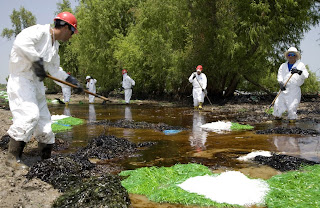
. The crew featured is working for a company called Trident out of Boston. Most of the workers don't speak English. The foreman told me that before the New Orleans spill his crew had been in Iowa cleaning up after the floods a month earlier. They had to remove dead pigs which were bloated after days of being submerged in the water and baking in the sun. Environmental disaster cleaner: now there is a profession that seems one could obtain steady work in.

Monday, July 28, 2008

News on the oil spill in New Orleans


The story line, “Things are almost back to normal on the Mississippi River” isn't so. That is what I’m hearing from the national media and the local media too. Their information source is the Coast Guard, who are carefully controlling access both to the scene of the spill and the information the public is allowed to hear. They mention that the clean up is ongoing, but the illusion that things are greatly improving along the river bank isn’t what I am finding when I explore with my camera in hand. Starting from the shores in the French Quarter going down almost as far as Venice, where the river meets the coast, I have documented a different story.

Interest in the story is limited – The clean up is under control and the river is open. The story is over. Over? Only 77,000 gallons of oil mixed with water have been cleaned up out of the over 400,000 spilled, the barge is still wedged up against the Crescent City Connection. According to the briefing I attended today, the oil still in the tanker will be sucked out by divers, and it will still be days before the remaining vessels are removed. Is it leaking or not?

Each morning the workers find a fresh coat of oil where they left the day before in a much cleaner state.The massive clean up effort underway, described in the media as starting day two after the spill, was an exaggeration. The media were escorted to one spot where workers were cleaning – a couple of hundred workers, a photo op that made it into the newspaper and TV news. Monday the number of clean up crews is 1200; Tuesday it will be up to 2000. 2000 workers to cover 100 miles of coast that each day gets new deposits of oil, some of which is being spread by the boats that are once again moving on the river- some from the tanker which may or may not still be leaking, that can be described as massive. Yet from day two of the spill the media was describing a massive clean up when a couple hundred workers were on the scene A clear exaggeration. The amount of money changing hands post oil spill? Now that is massive. Deciding who gets the contracts and then the clean up companies getting set up, that has in fact taken a week.

On Saturday the coast guard showed the media the boat cleaning process. I saw first hand how boats that were contaminated near the site of the spill, were being cleaned off before being allowed to move upriver. At the briefing this morning it was reported that the first boat let through the oil filled waters wasn’t bad at all. By tomorrow afternoon all of the priority vessels that have been held up will have been sent on their way, and the river traffic will get back to normal by Wednesday. Questions remain- what is a clean vessel? - How much oil is it permissible to track into the Gulf of Mexico or up River? Who decides these amounts? Is the Government making it up as they go along or is there a way to regulate such things? I think a lot of the weights and measures are biased on how long the economy can afford the port being closed.

I photographed clean up crews on Sunday after being told not to-"for my own safety," I wasn't allowed anywhere down the levees. That didn't stop me. A basic rule in photography is to get a close as possible.

The workers told me though they cleaned the site the day before, today they were finding new oil on the surface: just as big a mess as when they first started. The clean up will go on for months. The process is in steps – first remove the oil on the surface (mopping with pompoms and using a boom to collect and stop the flow of the oil) then on the rocks (steam cleaning); then in the soil (dig it up and sift it). . The riverbank will need to be cleaned and re- cleaned until the EPA decides the workers are more disruptive to the eco-system than letting nature finish the job.

Though a small spill in comparison to the Exon Valdez (this spill is one-26th the size), it has other implications on the political landscape. On the 23rd, the day of the spill, McCain was meant to come to town and speak about how great off shore drilling will be for Louisiana and the country. His advisors had the good sense to cancel his visit. How would it look to have McCain taking a first hand look at what an oil spill looks like?

Oil fuels all the main stories of the day- The War, inflation due to the high cost of gas, the destruction of our eco-system: especially in Louisiana where the results of oil companies' works have wreaked havoc on the wetlands: the wet land being the first defense against storm surges such as the one caused by Katrina. Just before the spill congress decided protecting the wetlands wasn’t a local issue but a national one. This spill illustrates the fact that if the port of New Orleans is closed the whole country stands to be affected by the economic impact in the disruption of cargo.


Ironically, the area right at Tulane’s Natural History Museum is one of the most oil covered. This is a museum that Hank Bart (the director) and I have been working to open to the public. Our shared goal has been to educate people about their connection to the natural environment. Though a small spill compared to others in recent times, this one is a reminder that our dependency on oil is something we will have to reckon with, be it in the form of wars for control of resources, or the environmental impact from spills and usage.

Note on images- Images of workers and oil by the river bank are in Belle Chase near Tulane's Natural History Museum. I  took them on July 28th. The other images were shot  between July 25- 27 in the same area.


here is a link to a related article "EPA urges workers not to talk to media"

Thursday, July 24, 2008

Oil Spill in New Orleans: approximately 400,000 gallons of it


Yesterday when I learned of the spill I went over to the banks of the Mississippi in the French Quarter and took some pictures. The smell of the fuel oil polluting the air: it's noxious qualities enough  to give me a headache. Not a good day to sit at Café du Monde to sip café au lait and eat beignets .

Close to 1/2-million gallons of  crude oil spilled into the Mississippi River when a 600-foot Liberian flagged tanker called the Tintomara ran into a barge being pulled by a tugboat at 1:30 am.The clean up began yesterday, though it is still not operating on a massive scale as yet. The Mississippi is closed from New Orleans to the Gulf of Mexico (over 100 miles). There are disruptions in the ferry service in the area (for the most part it is completely closed down) and in the water service. Water will have to be trucked in to many of the municipalities. A major traffic pile up has begun on the river.
It was first reported that much of the oil would evaporate, but that isn’t the case. The oil is too thick and if not skimmed off the top of the river, it will sink. A handful of clean up crews were working all through the day yesterday and this morning. They are using a couple different techniques to remove the oil. One is laying out pom-pom like devices tied together along the coast to absorb the oil; another uses a boat that has a belt like apparatus that laps up the oils.

The investigation into the crash has revealed the tugboat operator had only an apprentice mate’s license and wasn’t qualified to be at the wheel. There are also rumors on NOLA’s website, in the comment section, after today’s article on the spill, claiming the operator had been fired for a failed drug test but then allowed back at a lower status. Whatever the case, this is the kind of crime that leaves us all victims. The ecosystem of Louisiana, the wetlands in particular, are fragile and already stressed by industry. New Orleans' first defense against hurricanes has taken another blow. The negative impact this spill will have on the environment is a story in the making.
“Is it a big spill?”, someone at the agency I gave my images to try to syndicate, asked?

“What is considered a big spill these days?” I wonder. It's big.