Showing posts with label Louisiana. Show all posts

Monday, April 11, 2011

Dead Kemp's Ridley Turtles Washing up in MS and an Update from Bay Jimmy

Dead Kemp's Ripley sea turtle in Waveland MS
Dead Kemp's Ridley sea turtle spray painted so it wont be counted twice 
Dead sea turtle left for days next on beach in Waveland MS
Dead Kemp's Ridley sea turtle in Pass Christina MS
Dead Kemp's Ridley sea turtles on the Mississippi beaches, images I kept seeing on Facebook posts, prompted me to check it out for myself. I found four in the course of three hours. The beaches where I found some of the turtles are closed as of Sunday due to high bacteria counts caused by runoff of fecal matter, I've been told, not oil and dispersant.


On Fox 8, a local news station, John Snell recently went out to Bay Jimmy as I did days before to check on the status of the marsh. He and I came back with very different visuals. Snell went out during high-tide, the time when the damage to the coast is hidden under water.I went out low tide after a storm, when the lasting effects of the BP oil spill are best seen. Neither of us came back with the full story. Coastal restoration is a huge issue in Louisiana, one that, like the oil spill, effects the whole nation. The science can't be told in soundbites. The opinions of business owners and politicians are important too, but one has to question the motivation of whoever is speaking. Facts trump opinion and unfortunately not much scientific evidence is available yet or has been shared in the mainstream media . The dolphin die offs are under wraps; researchers are under a standing gag order. During the spill, National Oceanic and Atmospheric Administration had one from the federal government and released more misinformation than fact.


The mess in the Gulf, yeah, it could have been way worse, but that doesn't mean it wasn't and still isn't bad. Who's to say what the lasting effects will be? Who's to judge how much the killing of the marsh grass by the oil and chemical will effect an already disappearing coast line? Why are dozens of endangered Kemp's Ridley turtles washing up dead? I don't have the answers, but I do believe in documenting what I have seen.


In an article by the AP on April 7, 2011 the day before I found the turtles, april 7th 2011 they they said NOAA was pointing the blame at fishing and shrimping boats as the cause of the turtles deaths. In response to the article on line Clint Guidry , president of the Louisiana shrimp association wrote, "Totally and utterly RIDICULOUS! Shrimper's have been using TED's ( turtle excluder devices) for years now, without these turtle mortality rates. This spike in turtle mortality should be placed squarely where it belongs, BP oil disaster and the use of toxic dispersants. What is the limit to the extremes the US agencies will go to protect BP's liability in this oil disaster?"


Before you go to a Gulf Coast beach, you should check government sites to see if the water is safe: That's what the Mississippi Department of Environmental Quality suggests. Their reports are meant to protect our health and safety. We rely on government regulatory agencies that check self-policing energy corporations that say they are not putting more pollutants into the environment than are legally permitted. Their work is of the utmost importance. But organizations like Mineral Management Service have grossly failed us. And if you watch tv or read news stories on line, you've seen BP ads telling us they are making the Gulf Coast whole again. How nice if that were true.


I don't have answers to any of the pressing concerns facing the Gulf Coast, but I do know something has failed the endangered Kemp's Ridely turtles and the loggerheads too. That much I know.
Oil in the marsh at Bay Jimmy
Oil remains where marsh grass was killed by the oil in Bay Jimmy

Dead marsh grass in Bay Jimmy
Oil washed further in to the marsh after a storm in Bay Jimmy 


Thursday, August 05, 2010

It's Not Over Til It's Over!


While the end may be near for the rogue BP oil well, the damage to Louisiana's wetlandscontinues. More oil is washing up, oil that has sunk into the ground is resurfacing and tropical storms push it deeper into the marshes. Scientists are concerned about the long term effects on the Gulf of Mexico's wildlife and fish from the toxic combination of dispersants and oil. Click here to see some of the oil being recovered from the water.


Admiral Thad Allen reports seeing little to no oil on recent flyovers. Plaquemines ParishPresident Billy Nungesser disagrees. On a trip out to Barataria Bay, Nungesser assessed the damage first hand. A low tide coupled with Northern winds made it possible to see oil washed deep into the wetlands. Fiddler crabs covered in oil scurried along the banks, while gulls fished the polluted waters.

Booms, skimmers and jack-up barges have been removed despite the protestation of parish presidents. Though a total environmental catastrophe appears to have been averted, it is too early to assess the long term damage to Louisiana's wetlands. It is unclear how much of the oil-saturated marsh grass will die, but any such loss will speed up coastal erosion. Click here to see footage of the Damage to the Marsh as seen from an airboat.

There is a growing concern among locals that the oil disaster story is being whitewashed. BP's pr team seems eager to call the disaster a wrap. Doug Suttles,Chief Operating Officer of BP Exploration and Production, reminisces about his first flight over the disaster in a July 20th BP video. He gushes about the extraordinary effort that he says has worked extraordinarily well. "There is just not a lot of oil out there, " he says . Nunngesser begs to differ. I sat down and talked to him after a trip to Barataria Bay. Listen to what he has to say here.

For images of the oil that is still out there click here. If this is what the 25% of the remaining oil looks like, the wetlands are still in trouble. Bob Cesca's article "The BP Disaster Continues Despite Cheerful Happy Talk" will make you question most major media sources' willingness to accept the Joint Information Center's pr. Who's doing the talking, the Coast Guard or BP or have they become one and the same? Who is allowing BP to pull up their assets, the booms andskimmers and barges, and run? Hurricane season has yet to peak. Kudos to Billy who speaks his mind when no one else will. As a sign on Route 23 that takes you through the heart of Plaquemines Parish says, "God Bless Billy."


Wednesday, November 18, 2009

Autumn brings subtle changes in Louisiana


Update from New Orleans:

This fall President Obama visited New Orleans for a town hall meeting. The USS New York, a battle ship built in Louisiana with recycled steel from the World Trade Center disembarked headed for its namesake. Justice of the Peace Keith Bardwell resigned weeks after the international press picked up the story of his refusal to marry an interracial couple. Republican Congressman Cao, who ran against former Democratic Congressman Jefferson, voted for the health care bill while Jefferson got a 13 year sentence for bribery and racketeering. Some of Mayor Ray Nagin’s close associates have been indicted on corruption charges, creating speculation on when it will be his turn. The Saints won eight games straight and along the shores of Lake Verret cypress trees turned shades of orange.

Check out an interview about my news book that was on Fox8's morning show on Nov. 17. 09 - link to interview To see more images shot at Lake Verret click here to see a set on Flickr.


Friday, January 02, 2009

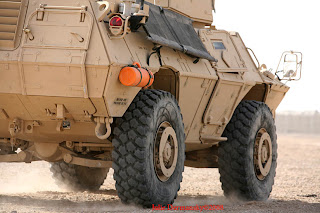
armored security vehicle


Back to the motor pool today for redundant check of the vehicles, making sure they are mission ready. I got a lesson in what makes the armored security vehicles special. Phin and I created a dispatch for Fox 8 (New Orleans affiliate of Fox) today after finding out the vehicles are made in Slidell Louisiana by Textron-who recently got a 300 million plus dollar contract to build a new batch. They have a 50-caliber machine gun and a grenade launcher with a turret that spins 360 degrees. These vehicles assistant troops as they patrol in search of IEDs (improvised explosive devises), operate traffic control points to escort dignitaries and go on security high speed conveys. Their thick armored shell and intimidating presence make them a vehicle of choice. I climbed in one of them. Pretty tight fit. No one with a twinge of claustrophobia could get in one of them with their Kevlar gear on without freaking out.

Wednesday, August 06, 2008

15 days after the oil spill


The barge is still lodged against the Crescent City Connection and sightings of oil-covered animals are mounting. Approximately 155 gallons of a mixture of oil and water have been cleaned up, but the percentage of oil to water is unknown. It is also not known how much of the 430,000 gallons of oil has already spilled and how much is left in the barge. The vessel is still leaking oil and crews are still pondering how to retrieve the remaining oil and the barge itself. Where are the experts? Are they stumped by the situation or are they not even here in New Orleans dealing with this spill?


On Friday I visited the animal rescue site in Venice, LA, a city that is located at the mouth of the Mississippi River, and took pictures of animal rescue workers from Texas’ SPCA, as they cleaned three birds of the four birds they had at the facility. The fourth bird was too stressed out to be cleaned so they decided to wait a day. Elizabeth Cook, a writer who accompanied me, wanted to know whether more animals were affected and why so few had been recovered for rescue. She didn’t get a definitive answer from the representative from the fish and wildlife department. Turns out there are four to six fish and wildlife boats searching 100 miles of river, maybe that accounts for the low number.

Hank Bark at Tulane’s Natural History Museum said the animals affected the most would die quickly and never be found, and others would get sick and weakened over time, but with so much land to cover the low recovery rate makes sense. As of yesterday, the number of recovered animals stands at 26 and some of those died before they were cleaned.

Dawn is the soap of choice for removing oil for animals. No intentional product placement here, just a fact.

The information at the news conferences I have attended has been vague at best. Yesterday the most reliable updates I could get were by going to the boardwalk where there is a view of the barge itself. The TV stations had crews staked out this morning in case the barge was to be lifted out of the water today, but that didn’t happen. The story is not in the news any longer now that commerce is back to normal but the situation remains tenuous. The barge is still a potential disaster waiting to happen and we don't know if the experts are here in New Orleans. Perhaps they are, and this has been deemed a wait and see situation. 


Monday, July 28, 2008

News on the oil spill in New Orleans


The story line, “Things are almost back to normal on the Mississippi River” isn't so. That is what I’m hearing from the national media and the local media too. Their information source is the Coast Guard, who are carefully controlling access both to the scene of the spill and the information the public is allowed to hear. They mention that the clean up is ongoing, but the illusion that things are greatly improving along the river bank isn’t what I am finding when I explore with my camera in hand. Starting from the shores in the French Quarter going down almost as far as Venice, where the river meets the coast, I have documented a different story.

Interest in the story is limited – The clean up is under control and the river is open. The story is over. Over? Only 77,000 gallons of oil mixed with water have been cleaned up out of the over 400,000 spilled, the barge is still wedged up against the Crescent City Connection. According to the briefing I attended today, the oil still in the tanker will be sucked out by divers, and it will still be days before the remaining vessels are removed. Is it leaking or not?

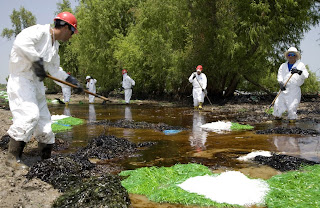
Each morning the workers find a fresh coat of oil where they left the day before in a much cleaner state.The massive clean up effort underway, described in the media as starting day two after the spill, was an exaggeration. The media were escorted to one spot where workers were cleaning – a couple of hundred workers, a photo op that made it into the newspaper and TV news. Monday the number of clean up crews is 1200; Tuesday it will be up to 2000. 2000 workers to cover 100 miles of coast that each day gets new deposits of oil, some of which is being spread by the boats that are once again moving on the river- some from the tanker which may or may not still be leaking, that can be described as massive. Yet from day two of the spill the media was describing a massive clean up when a couple hundred workers were on the scene A clear exaggeration. The amount of money changing hands post oil spill? Now that is massive. Deciding who gets the contracts and then the clean up companies getting set up, that has in fact taken a week.

On Saturday the coast guard showed the media the boat cleaning process. I saw first hand how boats that were contaminated near the site of the spill, were being cleaned off before being allowed to move upriver. At the briefing this morning it was reported that the first boat let through the oil filled waters wasn’t bad at all. By tomorrow afternoon all of the priority vessels that have been held up will have been sent on their way, and the river traffic will get back to normal by Wednesday. Questions remain- what is a clean vessel? - How much oil is it permissible to track into the Gulf of Mexico or up River? Who decides these amounts? Is the Government making it up as they go along or is there a way to regulate such things? I think a lot of the weights and measures are biased on how long the economy can afford the port being closed.

I photographed clean up crews on Sunday after being told not to-"for my own safety," I wasn't allowed anywhere down the levees. That didn't stop me. A basic rule in photography is to get a close as possible.

The workers told me though they cleaned the site the day before, today they were finding new oil on the surface: just as big a mess as when they first started. The clean up will go on for months. The process is in steps – first remove the oil on the surface (mopping with pompoms and using a boom to collect and stop the flow of the oil) then on the rocks (steam cleaning); then in the soil (dig it up and sift it). . The riverbank will need to be cleaned and re- cleaned until the EPA decides the workers are more disruptive to the eco-system than letting nature finish the job.

Though a small spill in comparison to the Exon Valdez (this spill is one-26th the size), it has other implications on the political landscape. On the 23rd, the day of the spill, McCain was meant to come to town and speak about how great off shore drilling will be for Louisiana and the country. His advisors had the good sense to cancel his visit. How would it look to have McCain taking a first hand look at what an oil spill looks like?

Oil fuels all the main stories of the day- The War, inflation due to the high cost of gas, the destruction of our eco-system: especially in Louisiana where the results of oil companies' works have wreaked havoc on the wetlands: the wet land being the first defense against storm surges such as the one caused by Katrina. Just before the spill congress decided protecting the wetlands wasn’t a local issue but a national one. This spill illustrates the fact that if the port of New Orleans is closed the whole country stands to be affected by the economic impact in the disruption of cargo.


Ironically, the area right at Tulane’s Natural History Museum is one of the most oil covered. This is a museum that Hank Bart (the director) and I have been working to open to the public. Our shared goal has been to educate people about their connection to the natural environment. Though a small spill compared to others in recent times, this one is a reminder that our dependency on oil is something we will have to reckon with, be it in the form of wars for control of resources, or the environmental impact from spills and usage.

Note on images- Images of workers and oil by the river bank are in Belle Chase near Tulane's Natural History Museum. I  took them on July 28th. The other images were shot  between July 25- 27 in the same area.


here is a link to a related article "EPA urges workers not to talk to media"

Tuesday, July 22, 2008

Flood Street-Still in Ruins From End to End


This morning I rode my bike the length of Flood St. in the Lower 9th Ward, from the wharf on the riverside to the levy. Flood Street is in very bad shape. Little has been rebuilt. I passed only a couple of construction crews and a handful of volunteers who were doing some landscape- 
work. I called a friend to get a reminder of what the codes painted on the homes by rescue crews stand for. 
The number at the 6 o’clock part of the X, is where the number of dead is recorded. Zero, in the case of the turquoise home I photographed. My friend looked up my coordinates on google maps and told me it looks like a sea of blue tarps from above. The scarred landscape and homes with boarded up entry points, illustrates Katrina’s story. A telling hole in a roof of one building looks too deliberate to be wind damage. Someone must have hacked the roof open while escaping the rising water.
 I first visited Flood Street in November 2006. The irony of a street called Flood Street, was one too rich to pass by. 


The Battle Ground Baptist Church, closer to the levee where the water went over the roofs of most of the buildings, is still standing. Benches remain inside, but the mud and other rubbish has been cleaned off.


At 1806, I went in to reshoot a home I shot in April 2007. More of the contents have been removed and the lawn was now landscaped, but there are no signs any re-building. In the middle of the house was a picture of Jesus, that is no longer behind glass, as I found it in April, looking back at anyone who enters the empty room looking up at them. The most noticeable change since my last visit in February 2008, are the street signs. At that time most were still hand painted on posts. Now the street intersections sport new shinny signs marking Flood Street and its’ recovery.