Wednesday, September 12, 2012

Isaac's Messy Aftermath


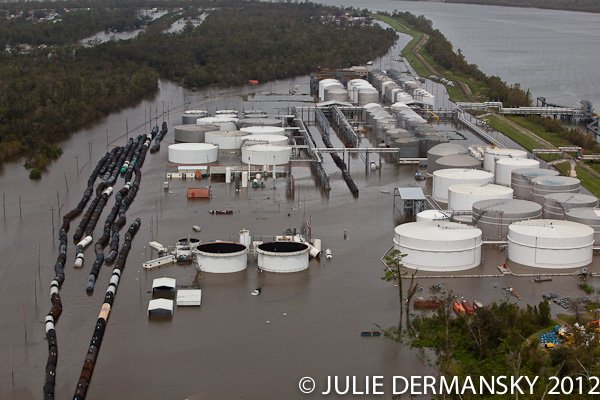
 Stolthaven Chemical Plant, Braitwaite
The depth of Isaac's destruction came into focus as the flood waters finally receded. The surge knocked homes off their foundations and toppled power lines for miles, stranding cars and cattle alike, it also toppled railroad cars full of toxins and hazardous chemicals parked at the Stolthaven Chemical Plant in Braitwaite. To date, there is no information about what was spilled and how much, but the spill was bad enough to mandate a half mile exclusion zone around the plant. Not until yesterday were residents who live near the plant allowed t to check on their homes and rescue belongings. Braitwaite residents who live beyond the exclusion zone go about there business hoping they are not being poisoned. Those I spoke to are skeptical about rebuilding in the area. With the chemical waste and the lack of flood protection they may decide to settle elsewhere. They blame the severity of the surge on the flood protection created for New Orleans. Though there is no proof as yet that New Orleans' massive Great Wall forced the water in their direction, Blake Miller says, "The water hitting the wall had to go somewhere." Oil washed up on the columns of St. Mary Plantation, the historic landmark he recently restored.

Since the BP oil spill when the government went along with BPs misinformation campaign, everyone in the area is skeptical of official information. The remnants of BP's oil spill are back, washing up on the beaches and in the marsh. So much for BP's tv commercials claiming the Gulf Coast is better than ever.

 Isaacs surge was predicted, but Solthaven was caught off guard. Doesn't a chemical plant have a responsibility to safeguard its neighbors when storms are coming? Is self regulation, like that of the oil ad gas industry, enough? Will Braitwaite become a toxic ghost town? For now, the beleaguered town is contending with visible dangers, watching out for snakes and red ants as they clean up the muck.. Their next job is dealing with insurance adjusters and FEMA representatives who are spreading the word that this time around it will not be like it was after Katrina, and they shouldn't expect as much.

Photos available through Corbis 
Stories on the Atlantic's website:  Eerie Vision on Highway 23 After Hurricane Isaac and
 After Isaac New Orleans Struggle to Rebound but Counts Its Blessings 

 *Linda Hopper-Bui from LSU supplied coordiantes to find the oil in Bay Baptiste that her tests confirmed as a match to the Macando (BP) well.
Hwy. 23 in  Plaquemiens Parish

Cows in house on Hyw. 23
Destroyed home in Briaitwaite
St, Mary’s Plantation in Briaitwaite

Blake Miller owner of St, Mary’s Plantation assesing the damages


Toxic chemical on the levee in Briaitwaite

Assumption Mission in Briaitwaite
Cow in house on Hwy. 23 in Plaquemines Parish

Coffin on the levee in Briaitwaite, Plaquemines Parish
 Cat Island eroded to less the half its size by Isaac.
BP oil in Bay Baptiste


Thursday, August 23, 2012

Any Given Sunday: Honoring the Dead in Santa Monica

Arlington West in Santa Monica
For the past nine years, Arlington West has been a fixture every Sunday on Santa Monica beach next to the amusement park on the pier. The memorial honoring American casualties of the wars in Iraq and Afghanistan is the work of Veterans For Peace and other volunteers. Each week they set out red, white and blue crosses, stars of David and crescent moons.The white markers represent one dead soldier; the red ones, ten. Blue markers signify the most recent casualties. In August a symbolic tombstone was added, commemorating the seven soldiers who take their own lives each week. In the  week ending August 19th, 11  American soldiers were killed in Afghanistan. On Sunday, two symbolic coffins were carried out and 11 pairs of boots were placed in front of 11 blue crosses to honor them. 

I asked Arlington West volunteer Linda Marasa what changes she has noticed over the years. She told me the tone of visitors has changed. She seldom meets any passerby who is offended by the memorial. People seem to feel the need to bring the soldiers home more than ever. Veteran and antiwar activist S. Brian Willson, who lost his legs while protesting an arms shipment to the Nicaraguan Contras, thinks the memorial's visual statement is a powerful reminder of the cost of war. He believes since there is no direct taxation for funding war and no draft, it is easy for most Americans to detach themselves from what is going on. But the memorial is a constant reminder that we are still at war. Willson thinks the memorial should be much bigger than it is, with markers for each dead Iraqi, Afghan, and Pakistani killed too.

The Veterans for Peace plan to continue setting up the memorial every Sunday until the war is over. They hope another war isn't started before this one ends.

 To see more images and read more about Arlington West check out my set on flickr from years past.


Carrying out coffin

Bringing Attention to Military Suicides
Santa Monic Beach on Sunday


Visitor book
Adam J Crumpler


Anti War activist S. Ryan Wilson, who lost his legs trying to stop a train carrying weapons, visits Arlington West.

Visitor at Arlington West


Vietnam veteran Kenny White writing the weeks dead count 


Red crosses signify  ten dead; white signify one. Among the crosses are  stars of David and crescent moons.

Monday, August 13, 2012

Raw Deal Offered to Louisiana Fishermen in Aftermath of BP Oil Spill


Dean Blanchard breaks open a tar ball on Grand Isle
GO FISH, Gulf Organized Fisheries in Solidarity and Hope, held a conference on August 4 at the Alario Center in New Orleans, bringing together over 700 people including lawyers, scientists and fishermen to discuss the settlement of a class action suit against BP. Earlier this year, BP agreed to pay out $7.8 billion, to be divided among those affected by the oil spill. Each party that signs on to the class action suit will receive an equal share. The settlement covers economic loss and health problems.Lawyers warned that signing on now would make it impossible to collect additional benefits if business does not pick up or a spill-related illness later emerges. Some of those in dire need have accepted the settlement. Boat captains and business owners can get a one time payment of $25,000 and deck hands, $5,000 -- payments that hardly compensate them for losses they've already incurred, and won't help them in the future if the seafood industry collapses of if they get sick. Dean Blanchard, the largest shrimp wholesaler in Louisiana, described the settlement as a joke. He asked the audience "Why should a Florida fisherman get the same amount of money that I would get?" His business is still losing money every day. He wonders if the lawyers who represented Louisiana's interests in the case had been bought off by BP. Blanchard points out that Louisiana is getting more BP money set aside for coastal restoration than other states, but the people are getting the same amounts as those in states less affected. "Why are the politicians not fighting for the people?" he asks. Settlement payments will be subjected to tax, while settlement monies from 9/11 and Agent Orange claims were tax free, another point of contention. People should hang tight, he warned, until they can get a settlement that will feed their families for the rest of their lives since Barataria Bay,and other fishing grounds may never come back to what they were. "Look at Alaska and Mexico" he warns.

The scientist, Dr Richard Condrey, retired LSU coastal ecologist, explained how things could go from bad to worse. Some species of fish may never recover. Some crabs have shown changes in their reproductive organs which could lead to the eradication of species in the area. Billy Nungesser, president of Plaquemines Parish, was in attendance. He worries about the after effects of dispersants on people, plants and animals, and he's concerned that the coastal restoration plan overseen by the Army Corps of Engineers is problematic. The planners aren't talking to the local population, the people who know the area best. No-one is officially checking for oil anymore, although fishermen spot oil almost daily, Nungesser says. Rithy Om, a Cambodian shrimper from Buras part of Plaquemines Parish, says he often loses money when he goes out shrimping. With his overhead more then wiping out his profit since his catch is off. The Buras Cambodian community of about 50 families is helping each other through hard times, Om's daughter Lynda tells me. She doesn't know how long they can last but she can't imagine them moving. That area is all those families know and shrimping is what they do.
Signs on Seafood Inc. on Grand Isle

 The day after the conference I took a trip to Grand Isle to meet with Dean Blanchard to see first hand the tar balls he said are still washing up on the beach. It didn't take long to spot them.  Blanchard's business is way off. He loses money daily by staying open, but he can't see himself staying home. If he were to close his shrimp processing center, local fishermen would suffer even more, forced to take their catch miles away. Tuna Phan's boat came in to process his shrimp. After paying all his expenses for the trip and paying his deck hands, he will make $400 for nine days work. At least he'll be able to feed his family he tells me. His catch of the day included tiger shrimp, an invasive species threatening Gulf shrimp along with the chemicals in the water. Blanchard can't stay on the beach very long. He has to head to Biloxi where he will meet with the team of lawyers working on his case. He will not stay quiet about what is happening nor will he settle for less than what he believes BP owes him. No one will buy him off. If anything, he would like to buy off the state officials to fight BP, but Governor Jindal, who denied taking BP money, shrugged him off when he inquired, "What would it cost to bring you over to the people's side?"

 BP commercials rub salt in the wounds of Louisiana fishermen. "Making Us Whole," the BP slogan, is a running joke. No wonder BP declined an invitation to send representatives to the GO FISH conference. 


Billy Nungesser with Dean Blanchard at the GO FISH conference


GO FISH conference in the Alario Center in Westwego
Diagram of health isues found in female crabs
Rithy Om, Cambodian shrimper from Buras

Dead dolphin on Elmer's Island
Tourism Down on Elmer's Island and Grand Isle


Open Tar ball

Tiger Shrimp- Invasive speices


Crabber on Grand Isle with small catch

My coverage of  the BP oil spill is  on my website- www.juliedermansky.com and my books ( 2 on the oil spill) can be previewed and/or purchased on Blurb's site. 

Monday, August 06, 2012

Chick-fil-A During the National Kiss-in on August 3rd in Metairie Louisiana

Whosoever Believeth,  a 43 year old father, came to the Metairie, LA Chick-fil-A after hearing about the National Kiss-In planned for Chick fil-A franchises across America.  He wasn't there to kiss anyone, but to spread the word about what he believes  the to-do is all about. "This is not about free speech or freedom of religion," Whosever Believeth said. "This is about Chick-Fil-A giving money to the Family Research Council who actively oppose gay rights." Hundreds packed the Metairie Chick-fil-A on Wednesday's Appreciation Day to show support for the chain, but only two gay couples showed up for Thursday's National Kiss-In. The couples entered the store, kissed and left.


Clay, who wouldn't give his last name, was not impressed. "This is New Orleans," he said, "or close enough. Everyone has a gay family member or friend, everyone!." The Kiss-In couples seemed tame to him, so, with his girlfriend Rosy he demonstrated what a real kiss looks like for reporters on the scene. To

The two same sex couple kisses seemed authentic to me. All three kisses are posted here and a link to video of Whosever Beleiveth speaking about the issue that has many people  boycotting Chick-fil-A.

 To see/read my story on the Atlantic's website site on Chick-fil-A Appreciation Day also photographed in Metairie Louisiana click here. 


Friday, June 29, 2012

Perfect for Summer Reading - Larry Flynt's New Book


Larry Flynt was in New Orleans on June 21st promoting his new book, "One Nation Under Sex: How the Private Lives of Presidents, First Ladies and Their Lovers Changed the Course of American History," co-written by historian David Eisenbach. He held court at the Hustler gift shop on Bourbon Street, signing books, magazines and body parts.


 Chris Rose, New Orleans author of “One Dead in the Attic,” interviewed him for Fox 8." Like me, Rose is a fan of Flynt's work as a free speech activist. But I didn’t follow the conversation; I was more intent on capturing the moment. The men spoke in front of a wall of bras, Flynt seated in his signature gold wheel chair, as close to a hundred fans lined up to meet him. For the book signing, he moved to a table with a backdrop picturing Hustler pole dancers. Next to him sat two women clad in Hustler t-shirts that exposed plenty of cleavage. Flynt enjoyed the antics of his fans: One woman had him sign her ass and a man had Flynt sign his chest. Reverend Jonathan Falwell brought the biggest smile to his face when he introduced himself and gave Flynt a rainbow Bible. Falwell's father, the late Jerry Falwell, sued Flynt in the landmark case that ended up in the Supreme Court, Flynt victorious as the Court ruled in favor of free speech.


 I bought a copy of Flynt's book and had him sign it. The book's premise--sex scandals are used as a smoke screen to take our attention off more important issues--is spot on. His book puts these scandals in historical context, a great way to refresh one's knowledge of American history.


Larry Flynt with Chris Rose


Reverend Jonathan Falwell gives Flynt Bible


Flynt with his wife, daughter and associates 

Monday, June 25, 2012

Visit to Detroit

Blighted Home


American Flag painting on bodega's wall reflecting on Car


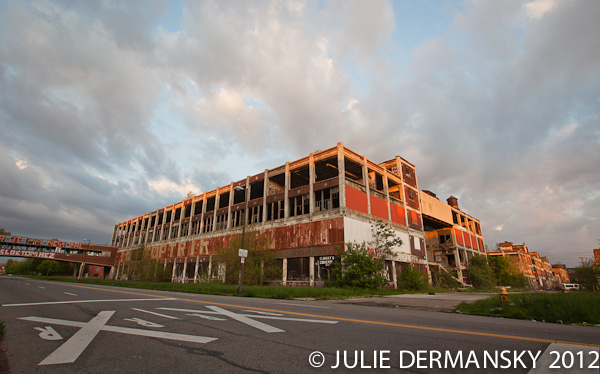
Cultural anthropology lured me to Detroit. My visit inspired by "ruin porn," photographic images of the deserted industrial landscape and my interest in the fading of The American Dream made Detroit fertile ground for a visual exploration. The blight in Detroit is the result of neglect and abandonment, not a natural disaster or flood triggered by crumbling infrastructure as was the case in New Orleans. As jobs in Detroit's automobile factories dried up, the city started its descent from bustling metropolis to industrial wasteland. Today Detroit is on the brink of financial collapse. Miles and miles of blighted neighborhoods overpower pockets of urban renewal that include hip restaurants, community gardens and an active art scene. 

Fischer Factory
 The Packard automative Plant has become a Mecca for graffiti artists and a tourist attraction. It is slated to be torn down in the summer of 2012. The natives, however, won't believe it until it happens; many blighted buildings have been set for demolition yet remain standing. Inside the sprawling compound where General Motors once spewed out cars is an environment in flux. The compound's structures are in various states of decay. Floor after floor in building after building, artwork covers the walls. Wind and the echoing voices of people exploring the ruins rustle through the empty spaces.

A bright spot in the landscape is the Heidelberg Project, a folk art installation that takes up two city blocks. Artist Tyree Guyton started the Project in 1986, using  homes, some habitable and some not, as his canvas. You come upon the Project as you're driving through East Detroit, a particularly tough part of the city. The brightly painted homes are a breath of fresh air, a sharp contrast to the nearby burnt-out structures and lots full of debris. The lots within the Project are hull of paintings on panels and playful sculptures, some made of stuffed animals. 

During my visit to Detroit I got a dose of local politics. People were talking about the fact that Detroit may become one of the first major American cities to be governed by an emergency manager, essentially privatizing all public services and taking away the citizens' vote in any decisions about the city's future. Emergency managers have been appointed in other Michigan cities, with unfavorable results. What happens in Detroit next will set a precedent for other American cities that have fallen on hard times. Will failing cities be on the action block for corporate takeover, or will they be given a chance to reinvent themselves, a longtime American tradition?

Check out my story and photo slide show on the Atlantic's website  
and set of photos on Flickr

Upstairs in Lee Plaza
Chase bank/ Blighted home
Plackard Plant
Occupy Detroit Protest against Bank of America
Upstairs inside the Placard Plant