Showing posts with label plaquemines parish. Show all posts

Wednesday, September 12, 2012

Isaac's Messy Aftermath


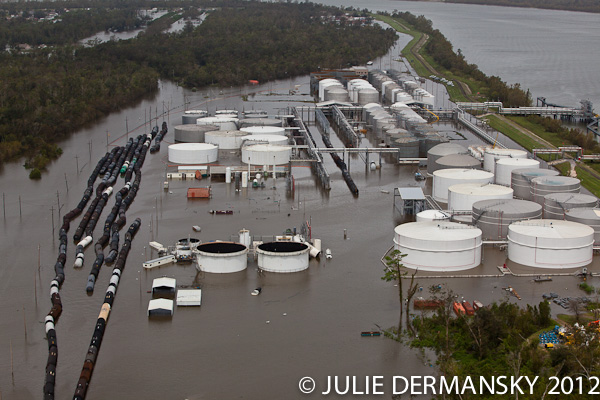
 Stolthaven Chemical Plant, Braitwaite
The depth of Isaac's destruction came into focus as the flood waters finally receded. The surge knocked homes off their foundations and toppled power lines for miles, stranding cars and cattle alike, it also toppled railroad cars full of toxins and hazardous chemicals parked at the Stolthaven Chemical Plant in Braitwaite. To date, there is no information about what was spilled and how much, but the spill was bad enough to mandate a half mile exclusion zone around the plant. Not until yesterday were residents who live near the plant allowed t to check on their homes and rescue belongings. Braitwaite residents who live beyond the exclusion zone go about there business hoping they are not being poisoned. Those I spoke to are skeptical about rebuilding in the area. With the chemical waste and the lack of flood protection they may decide to settle elsewhere. They blame the severity of the surge on the flood protection created for New Orleans. Though there is no proof as yet that New Orleans' massive Great Wall forced the water in their direction, Blake Miller says, "The water hitting the wall had to go somewhere." Oil washed up on the columns of St. Mary Plantation, the historic landmark he recently restored.

Since the BP oil spill when the government went along with BPs misinformation campaign, everyone in the area is skeptical of official information. The remnants of BP's oil spill are back, washing up on the beaches and in the marsh. So much for BP's tv commercials claiming the Gulf Coast is better than ever.

 Isaacs surge was predicted, but Solthaven was caught off guard. Doesn't a chemical plant have a responsibility to safeguard its neighbors when storms are coming? Is self regulation, like that of the oil ad gas industry, enough? Will Braitwaite become a toxic ghost town? For now, the beleaguered town is contending with visible dangers, watching out for snakes and red ants as they clean up the muck.. Their next job is dealing with insurance adjusters and FEMA representatives who are spreading the word that this time around it will not be like it was after Katrina, and they shouldn't expect as much.

Photos available through Corbis 
Stories on the Atlantic's website:  Eerie Vision on Highway 23 After Hurricane Isaac and
 After Isaac New Orleans Struggle to Rebound but Counts Its Blessings 

 *Linda Hopper-Bui from LSU supplied coordiantes to find the oil in Bay Baptiste that her tests confirmed as a match to the Macando (BP) well.
Hwy. 23 in  Plaquemiens Parish

Cows in house on Hyw. 23
Destroyed home in Briaitwaite
St, Mary’s Plantation in Briaitwaite

Blake Miller owner of St, Mary’s Plantation assesing the damages


Toxic chemical on the levee in Briaitwaite

Assumption Mission in Briaitwaite
Cow in house on Hwy. 23 in Plaquemines Parish

Coffin on the levee in Briaitwaite, Plaquemines Parish
 Cat Island eroded to less the half its size by Isaac.
BP oil in Bay Baptiste


Wednesday, September 22, 2010

Third Major Fish Kill in One Week


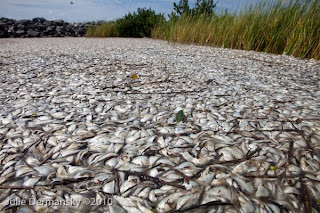
On September 19th, BP pronounced its Macando well dead. End of story? Hardly. A September 19th trip along the coast of Bay Jimmy in Plaquemines Parish proved the oil is still out there , and more and more fish kills have been reported. According to the AP, Wildlife and Fisheries are writing off the recent fish kills: Lack of oxygen caused by low tide and high temperatures suffocated the fish, they say. The National Oceanic and Atmospheric Administration stated oxygen levels had fallen by 20 percent if areas of the gulf where plumes of oil were found according to an article in the Times of London by Jacqui Goddard.

P. J. Hahn, director of the Coastal Zone Management Department of Plaquimines Parish, agrees the fish suffocated, but he isn't so sure the BP oil disaster isn't in some way connected. He showed me the spot in Bayou Robinson where he found a new fish kill on Sept. 18th, the third reported in one week. Finding the spot wasn't too hard, the smell unmistakable. Birds and dolphins were feasting on the dead fish like an X marking the spot.
The predominant species found floating on the surface were menhaden, also called pogie, mixed with crab and catfish. Unlike the first major fish kill on Sept 15th, a thin coating of oil was visible on many of the fish. Though fish kills are a common occurrence at the end of the summer, their current frequency and scale are unprecedented, Hahn explained. It is impossible to rule out oil or dispersant as factors until tests are done.

Hank Bart, an ichthyologist at Tulane's Natural History Museum, concurs. "Fish kills are caused by organism booms, either bacterial or algae, that suck the oxygen out of the water. The cause for such growths come from a variety of circumstances that can't be determined without testing."

Plaquemines Parish president Billy Nungesser, who has been fighting for faster and greater action all along, acknowledged it is good to hear the well is finally dead; however, he stressed he will fight BP and the government till the end to make sure his parish has been made whole again, as promised. Plaquemines Parish's district attorney is conducting his own tests with the help of a specialist from Alaska, not relying solely on the federal government's testing. On the upside, scientists and lawyers in the region won't be short of work any time soon. "can anybody look the American people in the eye and say it absolutely has nothing to do with dispersants, the oil, or the breakdown of the oil, or does anybody care? I mean somebody has to be as upset as I am?" Nungesser asked.

WWL TV in New Orleans followed up by interviewing an agent from Louisiana Wildlife and Fisheries, who said no testing was deemed necessary because his agents found no sign of pollution at the site of the fish kills. 30 minutes later the another representative from Louisisana Wildlife and Fisheries called WWL and said the fish from Bayou Robinson would be tested after all.
To see the story shot by Phin Percy for Fox 8 on the fish kill click here


Images- all images were shot on Sept. 19, 2010: fish kill in Bayou Robinson, oil in Bay Jimmy


to see more images of Bay Jimmy and the fish kill click here