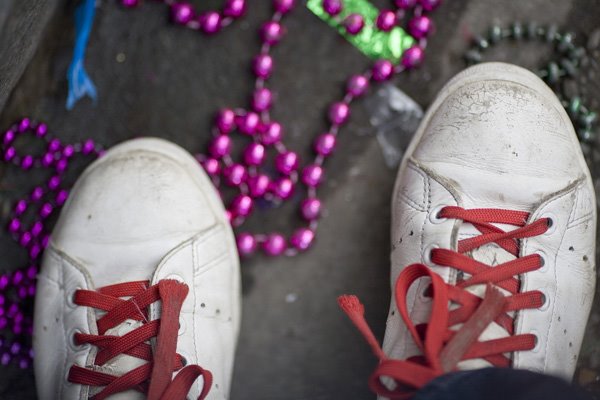
My exhibition with Ann McGarrell opened on May 30th and was well received. Ann and I will be on Vermont Public television. I will post a link to the TV spot once it is posted on Utube. The objects i rescued from homes slated for destruction in New Orleans last year, reverberated in the gallery once they were on packed and placed on pedestals complimenting my photos and Ann's Poem.
 Check out a book that combines photos and poetry from the exhibition Revenants: A New Orleans Reliquary. Post-Katrina Photographs by Julie Dermansky with Poems by Ann McGarrell at AVA Gallery and Art Center from May 30 - June 28, 2008. . The book is 9 by 7 inches, soft cover, 40 pages with 26 color plates. The book can be purchased directly from blurb's web site at it costs 29.95. you can check out 15 sample pages.

In Revenants: A New Orleans Reliquary, Post-Katrina Photographs by Julie Dermansky with Poems by Ann McGarrell, the collaboration between a visual artist and a writer offers us an occasion to reflect on the tragedy of New Orleans on a personal and emotional level. Over a year after Hurricane Katrina struck, Dermansky began a series she continues to revisit today. The work in the book was shot between November 2006 and March 2008. Dermansky began documenting Katrina’s tragic aftermath block by block when she discovered that New Orleans has been left in a state of devastation and decay. Writer Ann McGarrell, a longtime observer of New Orleans’s pleasures and menaces, was inspired by Julie Dermansky’s work and set about crafting the poems that grew into this collaborative book and accompanying exhibition Ann McGarrell is a writer and translator whose poems and essays have appeared in American and British magazines since the 1960s. Her poetic collaboration with the painter Jack Beal, Flora, was published in 1990. In 2003, she was the recipient of a Bogliasco Fellowship in Literature, and her translation of Vittoria Ronchey’s The Face of Isis received the 1997 PEN/Renato Poggioli award for best translation from the Italian. She lives in Newbury, Vermont, with her husband, the painter James McGarrell, whose lifelong devotion to New Orleans and its music is, along with Julie Dermansky’s powerful photographs, one of the sources of her Revenants poems.




 Posts
Posts