Showing posts with label environmental disaster. Show all posts

Monday, August 22, 2011

Industrial Incident Causes Massive Fish Kill in Louisiana

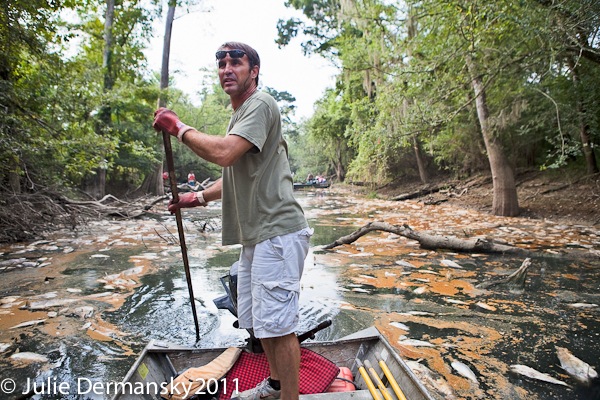
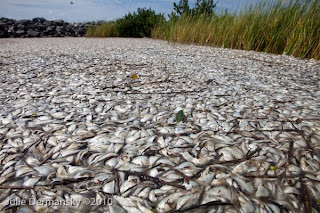
Another industrial incident takes a toll on the environment in Louisiana. The Temple-Inland paper mill in Bogalusa has taken responsibility for a fish kill in Pearl River and its tributaries stemming from an incident that began over a week ago. Attached are images I shot on Aug. 18 and 19th of the fish kill and the cleanup.

The paper mill knew they had a problem when they exceeded their limit of allowable discharge into the Pearl River. They didn't report the incident to DEQ ( Department of Environmental Quality) immediately, nor did they stop production. When they did cease operation, enough black liquor, a byproduct of the paper-making process, was released into the river to cause a major kill of fish including carp, drum catfish, eels , sardines and the endangered sturgeon, shellfish and turtles along 40 miles of river. By the end of this weekend, most of the dead fish have been picked up. Water fouled by chemicals that caused oxygen depletion have been flushing out into bigger bodies of water--first into the Rigolets and from there into Lake Pontchartrain and Lake Borgne, which both connect to the Gulf of Mexico. Damage to the Rigolets and the lakes is being monitored by the DEQ and other concerned parties. On the August 20, crabbers reported pulling up hundreds of traps full of dead crabs ( see local news report here  ) .
To see more images this link is to a set on Flickr  .
To see a video clip click here.
Nature's resiliency is remarkable. Though the tributary I documented was full of death, the maggots were very much alive, feasting on the fish carcasses. The Pearl River and other bayous I explored had signs of life returning, despite the black film still present in the water.


Wednesday, April 20, 2011

A Year After the BP Oil Disaster; A Walk on Mississippi Beaches

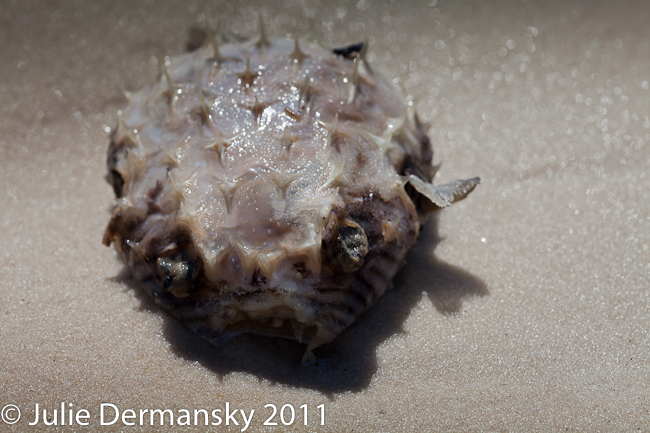
Last weekend I went to Mississippi's Gulf Coast beaches. I arrived just before sunset. Before the light was gone I photographed four dead sea turtles and a variety of other animals--birds, jellyfish, stingray, armadillo and catfish. I walked the beaches on Saturday and Sunday too, exploring different spots from Waveland to Gulfport and shot over 100 carcasses.


Animals die. Sometimes you find them on the beach. But I don't believe that what I found on the Mississippi beaches in normal . Click here to see what i found from ARPRIL 15-17th. Is the BP oil disaster the cause of these deaths? There is no scientific proof one way or the other. Is there a connection to the oil that spilled and the dispersants that were dropped on the Gulf's surface that spread through the air and have found their way into the blood of many of the oil spill clean up workers? I can't say for sure. It is clear it wont be easy to pin the animail deaths on BP, the corporation responsible for the largest environmental disaster in American history.


So, sticking to the facts, if you want to take photographs of dead animals, including endangered Kemp's Ridley sea turtles, head to the Mississippi beaches. Maybe the tourist industry that just received a generous chunk of money from BP ought to consider a new slogan"Visit our beaches where you can find a dead animals every 100 ft or so." A lot of us are into the macabre, right? The influx of dead animals could draw those into death to the coast which might balance out rooms lost to those concerned with the warnings at the beach warning people that the tar balls from the oil spill may be harmful to your health. Use the beach at your own risk..

To see more of my work on the BP oil disaster check out page on my site here.


Tuesday, March 22, 2011

Return Trip to Site Where Oil Coming From Unknown Source Was Found Off Grand Isle

 Emulsified oil 1/2 mile due south of Grande Isle on March 21st 
On March 21, I returned to Elmer's Island and Grand Isle, where the day before I photographed oil and oil sheen washing into Caminada Bay . The Coast Guard confirmed that there was oil on the water on March 21, but still hasn't identified the source. By Monday only a small amount of sheen and foam could be found. Some of the oil had already been cleaned off the beach, some was skimmed, but a lot of what I saw yesterday had already made its way into Caminada Bay, a rich estuary. About half a mile due south of Grand Isle, we encountered  a plume of emulsified oil. Plumes were reported by Jefferson Parish officials during flyovers the day before. Also off shore, we spotted a young dead dolphin, adding to the high number already reported this year by New Oceanic and Atmospheric Administration.


This new oil spill raises many questions: What is the source of the oil and is it still leaking? How much of it is there? Could it be connected to the BP disaster? Is it a good idea to restart deepwater drilling? Are the regulators regulating? Why are the polluters often not fined the maximum allowed and why do regulators let some code breakers get away without any penalty? And what is causing an unusually high number of young dolphins to die?  The answers are still up in the air, but the Coast Guard, NOAA and private citizens are all busy trying to get the facts.


Dead young dolphin found floating in the Gulf, cause of death undeterminedadding to the abnormally high dolphin mortality  rate this year. 
Emulsified oil 1/2 mile due south of Grande Isle on March 21st
Boom put out on March 21st across the cut leading into Caminada Bay, an rich estuary. Oil washed through the cut on March 20th. See video clip of oil getting in 


Emulsified oil 1/2 mile due south of Grande Isle on March 21st 


Saturday, October 09, 2010

BP Oil Left Behind in Louisiana


I got a call from Grace Welch asking me to come to Terribone Parish to see the oil BP is leaving behind as the clean-up efforts to an end. Welch is a Pointe-au-Chien Indian from Pointe-au-Chien, LA. The community has taken a bad blow from the BP oil spill since most people make a living from fishing, shrimping, crabbing and oyster harvesting. Though their ancestral fishing grounds weren't as badly polluted as Bay Jimmy in Plaquaemines Parish or the beaches near Grand Isle, the marsh was fouled by BP oil. The marsh grass along the shores in Lake Chien and Lake Raccaurci that got coated in oil in May has died. Today a gooey swath of oil lines the shore. BP never cleaned this area. Some boom was put out after the oil had already gotten into the marsh and then was later removed. That was the extent of the clean up, Russell Dar Dar, an elder tribe member told me.

A few members of the tribe are still employed by BP in Terribone Parish, working off Cocodrie where they are removing oil drenched absorbent boom that has washed up on marshland. Once this boom is picked up, the clean up in Terribone Parish will be over. BP claims it will do the marsh more harm than good to clean it up. Where is their scientific justification coming from? Could it really be that leaving thick oil on the shore that has already killed the grass, to sink deeper into the soil, is a good thing? I watched birds hunting shrimp , sticking their beaks into the oily goop to catch their prey. Maybe a little oil isn't a bad thing?

A company called Gulfsavers has a solution that is not invasive to the march. Their product, made with oil-eating microbes, would help speed up the natural decomposing proccess. They have been unable to get BP to buy their product and are hoping enough donations will come in so that they can get some of their product in place and do their part in cleaning the marshland.

Dar Dar and I watched a shrimp boat at work just a few yards from the oil coated shore, in waters recently re-opened to fishing. We both wonder who would want to eat those shrimp if they saw the spot from which they came. Dar Dar has collected oysters that are being tested by the the Bucket Brigade (http://www.labucketbrigade.org/article.php?list=type&type=4) so he can decide whether or not he will resume oyster harvesting for the Thanksgiving season . Dar Dar is worried about the future. He no longer trusts what he is told. The BP oil disaster taught him the power of lies: If they are repeated often enough, people believe them. Dar Dar goes by what he sees and is having his own testing done.

Wednesday, September 22, 2010

Third Major Fish Kill in One Week


On September 19th, BP pronounced its Macando well dead. End of story? Hardly. A September 19th trip along the coast of Bay Jimmy in Plaquemines Parish proved the oil is still out there , and more and more fish kills have been reported. According to the AP, Wildlife and Fisheries are writing off the recent fish kills: Lack of oxygen caused by low tide and high temperatures suffocated the fish, they say. The National Oceanic and Atmospheric Administration stated oxygen levels had fallen by 20 percent if areas of the gulf where plumes of oil were found according to an article in the Times of London by Jacqui Goddard.

P. J. Hahn, director of the Coastal Zone Management Department of Plaquimines Parish, agrees the fish suffocated, but he isn't so sure the BP oil disaster isn't in some way connected. He showed me the spot in Bayou Robinson where he found a new fish kill on Sept. 18th, the third reported in one week. Finding the spot wasn't too hard, the smell unmistakable. Birds and dolphins were feasting on the dead fish like an X marking the spot.
The predominant species found floating on the surface were menhaden, also called pogie, mixed with crab and catfish. Unlike the first major fish kill on Sept 15th, a thin coating of oil was visible on many of the fish. Though fish kills are a common occurrence at the end of the summer, their current frequency and scale are unprecedented, Hahn explained. It is impossible to rule out oil or dispersant as factors until tests are done.

Hank Bart, an ichthyologist at Tulane's Natural History Museum, concurs. "Fish kills are caused by organism booms, either bacterial or algae, that suck the oxygen out of the water. The cause for such growths come from a variety of circumstances that can't be determined without testing."

Plaquemines Parish president Billy Nungesser, who has been fighting for faster and greater action all along, acknowledged it is good to hear the well is finally dead; however, he stressed he will fight BP and the government till the end to make sure his parish has been made whole again, as promised. Plaquemines Parish's district attorney is conducting his own tests with the help of a specialist from Alaska, not relying solely on the federal government's testing. On the upside, scientists and lawyers in the region won't be short of work any time soon. "can anybody look the American people in the eye and say it absolutely has nothing to do with dispersants, the oil, or the breakdown of the oil, or does anybody care? I mean somebody has to be as upset as I am?" Nungesser asked.

WWL TV in New Orleans followed up by interviewing an agent from Louisiana Wildlife and Fisheries, who said no testing was deemed necessary because his agents found no sign of pollution at the site of the fish kills. 30 minutes later the another representative from Louisisana Wildlife and Fisheries called WWL and said the fish from Bayou Robinson would be tested after all.
To see the story shot by Phin Percy for Fox 8 on the fish kill click here


Images- all images were shot on Sept. 19, 2010: fish kill in Bayou Robinson, oil in Bay Jimmy


to see more images of Bay Jimmy and the fish kill click here

Friday, June 11, 2010

BP Oil Leak Update In Pictures


Politicians and BP officials who assure the public all that can be done is being done to protect and clean up the Gulf Coast might want to reconsider such statements. That is not what I have seen. Brown pelicans on Queen Bess Island are living dangerously close to splotches of oil stuck inside and outside the boom meant to protect the island. Many of them have been rescued by wildlife and fishery officials, while countless others have died. The cleanup effort ramps up when VIP's are around; other than that, the cleanup and containment effort is sporadic at best. Last weekend, Christopher Hernandez of Grand Isle called members of the press down to show them around the day after 600 workers were bussed in to clean the beach for Obama's visit. Post-Obama, the cleanup crews numbers dwindled and their work hours were almost nonexistant.

For a multi-media story for the Atlantic featuring Chris and his take on BP controlling the media on Grand Isle, Also check out a photo essay for the Washington Post on the Pointe au Chien Indians I have updated my set on Flickr and it will continue to grow.


Images- top to bottom -A reporter puts his hand in an oil patch on the surface of Barataria Bay/Sign on Grand Isle, where BP's oil spill has shut down the fishing industry and washed up on shore/Brown pelican covered in oil on Barataria Bay off the coast of Grand Terre Island/ Chris Hernandez, Street Superintendent of Grand Isle, on Grand Isle beach/Baby tern stuck in an oil patch on Grand Isle beach, rescued by Chris Hernandez/ Pelican, being cleaned at Fork Jackson in Buras Louisiana/ Living quarters for cleanup workers on a barge stationed in Lake Barre/ Jake Billiot, a Pointe-au-Chien Indian, in front of the place of business where he used to sell shrimp in Point aux- Chene. The shrimp season was canceled on May 30th due to oil from the BP leak contaminating the waters. Jake has been a fisherman his whole life. Jake signed on to work for BP putting out boom since no other work is available to him

Thursday, August 14, 2008

New Orleans Oil Spill Story: A Footnote in the Annals of Oil Spills


On Saturday, August 9th the hull of the sunken barge was recovered from the Mississippi River. I was on location snapping away as the barge's stern dangled in the air. The remaining part of the barge was removed Sunday.
 The process started early in the morning and ended around 1 a.m., an engineering feat that took over two weeks to orchestrate. Oil leaked out of both pieces as they were moved but booms and skimmers were ready to clean the mess as it occurred (unlike when the barge "burped"
 and the clean up crews were unprepared). These images might seem to represent the end of the story, but they don't. Oil is still covering much of the river's , shoreline and animals are still getting sick. I plan to continue moniterring the clean up process until I head to NYC in September, making sure the crews are still on it and haven't been run off before the clean up is done.

In the history of oil spills, the one that polluted New Orleans on July 23rd wasn't a major one. When between 280,000 to 430,000 leaked gallons is defined as a small spill, it should give one pause. Even though this one is "small" it serves as a loud wake up call, reminding us our ecosytem is in danger when oil is transported. I wonder if anyone is listening?
The trail meant to establish whose fault the accident was begun on the 12th of August . The findings won't answer all the questions that still remain: Who will pay for the clean up? And will the river's coast be cleaned up as well as it could be? Which larger companies are the smaller ones subsidiaries of? Who is profiting from the spill: the usual suspects? Will anything be learned by those regulating the transport of oil from this incident or are oil spills just part of doing buisiness?

The best result would be if those involved in the process of transporting oil and those who regulate the waterways took pause and put more safeguards in places to prevent such accidents from occurring in the future -- a highly unlikely outcome since the politicians in New Orleans, LA and in the federal government have given this spill little of no attention.I went out on a boat with the coastguard in Venice at the mouth of the Mississippi the last time I shot the birds being cleaned at the temporary animal rescue center manned by the SPCA out of Houston.
Some oil has gotten into the marshes. I saw none on the booms set up there but the oil did make its way that far. The boat’s captain explained to me where all the coastal erosion has taken place, showing me an artificial opening in the river that is hleping to erode the land. The wetlands don't stand a chance if things keep on as they are. They might already be past the point of viable proection. The road names off Highway 23 say it all. The coast guard dock is just past Halliburton Road. Venice is an oasis for oil producing companies even though Katrina took out the town's infrastructure.

Filmmaker Phin Percy Jr. shot video while I was shooting the clean up work
. The crew featured is working for a company called Trident out of Boston. Most of the workers don't speak English. The foreman told me that before the New Orleans spill his crew had been in Iowa cleaning up after the floods a month earlier. They had to remove dead pigs which were bloated after days of being submerged in the water and baking in the sun. Environmental disaster cleaner: now there is a profession that seems one could obtain steady work in.

Wednesday, August 06, 2008

15 days after the oil spill


The barge is still lodged against the Crescent City Connection and sightings of oil-covered animals are mounting. Approximately 155 gallons of a mixture of oil and water have been cleaned up, but the percentage of oil to water is unknown. It is also not known how much of the 430,000 gallons of oil has already spilled and how much is left in the barge. The vessel is still leaking oil and crews are still pondering how to retrieve the remaining oil and the barge itself. Where are the experts? Are they stumped by the situation or are they not even here in New Orleans dealing with this spill?


On Friday I visited the animal rescue site in Venice, LA, a city that is located at the mouth of the Mississippi River, and took pictures of animal rescue workers from Texas’ SPCA, as they cleaned three birds of the four birds they had at the facility. The fourth bird was too stressed out to be cleaned so they decided to wait a day. Elizabeth Cook, a writer who accompanied me, wanted to know whether more animals were affected and why so few had been recovered for rescue. She didn’t get a definitive answer from the representative from the fish and wildlife department. Turns out there are four to six fish and wildlife boats searching 100 miles of river, maybe that accounts for the low number.

Hank Bark at Tulane’s Natural History Museum said the animals affected the most would die quickly and never be found, and others would get sick and weakened over time, but with so much land to cover the low recovery rate makes sense. As of yesterday, the number of recovered animals stands at 26 and some of those died before they were cleaned.

Dawn is the soap of choice for removing oil for animals. No intentional product placement here, just a fact.

The information at the news conferences I have attended has been vague at best. Yesterday the most reliable updates I could get were by going to the boardwalk where there is a view of the barge itself. The TV stations had crews staked out this morning in case the barge was to be lifted out of the water today, but that didn’t happen. The story is not in the news any longer now that commerce is back to normal but the situation remains tenuous. The barge is still a potential disaster waiting to happen and we don't know if the experts are here in New Orleans. Perhaps they are, and this has been deemed a wait and see situation. 


Monday, July 28, 2008

News on the oil spill in New Orleans


The story line, “Things are almost back to normal on the Mississippi River” isn't so. That is what I’m hearing from the national media and the local media too. Their information source is the Coast Guard, who are carefully controlling access both to the scene of the spill and the information the public is allowed to hear. They mention that the clean up is ongoing, but the illusion that things are greatly improving along the river bank isn’t what I am finding when I explore with my camera in hand. Starting from the shores in the French Quarter going down almost as far as Venice, where the river meets the coast, I have documented a different story.

Interest in the story is limited – The clean up is under control and the river is open. The story is over. Over? Only 77,000 gallons of oil mixed with water have been cleaned up out of the over 400,000 spilled, the barge is still wedged up against the Crescent City Connection. According to the briefing I attended today, the oil still in the tanker will be sucked out by divers, and it will still be days before the remaining vessels are removed. Is it leaking or not?

Each morning the workers find a fresh coat of oil where they left the day before in a much cleaner state.The massive clean up effort underway, described in the media as starting day two after the spill, was an exaggeration. The media were escorted to one spot where workers were cleaning – a couple of hundred workers, a photo op that made it into the newspaper and TV news. Monday the number of clean up crews is 1200; Tuesday it will be up to 2000. 2000 workers to cover 100 miles of coast that each day gets new deposits of oil, some of which is being spread by the boats that are once again moving on the river- some from the tanker which may or may not still be leaking, that can be described as massive. Yet from day two of the spill the media was describing a massive clean up when a couple hundred workers were on the scene A clear exaggeration. The amount of money changing hands post oil spill? Now that is massive. Deciding who gets the contracts and then the clean up companies getting set up, that has in fact taken a week.

On Saturday the coast guard showed the media the boat cleaning process. I saw first hand how boats that were contaminated near the site of the spill, were being cleaned off before being allowed to move upriver. At the briefing this morning it was reported that the first boat let through the oil filled waters wasn’t bad at all. By tomorrow afternoon all of the priority vessels that have been held up will have been sent on their way, and the river traffic will get back to normal by Wednesday. Questions remain- what is a clean vessel? - How much oil is it permissible to track into the Gulf of Mexico or up River? Who decides these amounts? Is the Government making it up as they go along or is there a way to regulate such things? I think a lot of the weights and measures are biased on how long the economy can afford the port being closed.

I photographed clean up crews on Sunday after being told not to-"for my own safety," I wasn't allowed anywhere down the levees. That didn't stop me. A basic rule in photography is to get a close as possible.

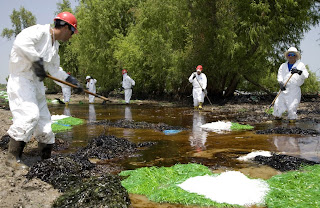
The workers told me though they cleaned the site the day before, today they were finding new oil on the surface: just as big a mess as when they first started. The clean up will go on for months. The process is in steps – first remove the oil on the surface (mopping with pompoms and using a boom to collect and stop the flow of the oil) then on the rocks (steam cleaning); then in the soil (dig it up and sift it). . The riverbank will need to be cleaned and re- cleaned until the EPA decides the workers are more disruptive to the eco-system than letting nature finish the job.

Though a small spill in comparison to the Exon Valdez (this spill is one-26th the size), it has other implications on the political landscape. On the 23rd, the day of the spill, McCain was meant to come to town and speak about how great off shore drilling will be for Louisiana and the country. His advisors had the good sense to cancel his visit. How would it look to have McCain taking a first hand look at what an oil spill looks like?

Oil fuels all the main stories of the day- The War, inflation due to the high cost of gas, the destruction of our eco-system: especially in Louisiana where the results of oil companies' works have wreaked havoc on the wetlands: the wet land being the first defense against storm surges such as the one caused by Katrina. Just before the spill congress decided protecting the wetlands wasn’t a local issue but a national one. This spill illustrates the fact that if the port of New Orleans is closed the whole country stands to be affected by the economic impact in the disruption of cargo.


Ironically, the area right at Tulane’s Natural History Museum is one of the most oil covered. This is a museum that Hank Bart (the director) and I have been working to open to the public. Our shared goal has been to educate people about their connection to the natural environment. Though a small spill compared to others in recent times, this one is a reminder that our dependency on oil is something we will have to reckon with, be it in the form of wars for control of resources, or the environmental impact from spills and usage.

Note on images- Images of workers and oil by the river bank are in Belle Chase near Tulane's Natural History Museum. I  took them on July 28th. The other images were shot  between July 25- 27 in the same area.


here is a link to a related article "EPA urges workers not to talk to media"